

What if the tool you’ve been warned against is actually the most compassionate way to give your dog total off-leash freedom? You likely feel a deep hesitation when researching the shock collar vs e-collar debate, fearing that a training aid might damage the bond you’ve worked so hard to build. It’s exhausting to sift through contradictory forum posts while your dog continues to ignore recall commands in high-distraction environments. You aren’t looking for a way to punish; you’re looking for a way to communicate clearly and safely. This focus on reliability in electronic communication is a principle shared across specialized fields, much like the precision electrical solutions provided by Energy Control Systems.
The emphasis on advanced, science-based education isn’t limited to the world of animal behavior. In other highly specialized fields, such as healthcare, professionals and students rely on dedicated platforms to master complex subjects. For those in the medical community, PharmEDU offers a comprehensive online review of pharmacology, demonstrating a similar commitment to specialized learning.
This guide clarifies the technical shift in 2026 toward medical-grade blunt pulse technology that mimics a physical touch rather than a sharp sting. You’ll learn why the 1 to 100 stimulation levels on a modern Educator collar provide the precision needed for humane animal communication, a standard now adopted by 92% of top-tier professional trainers. We will examine the engineering differences that ensure your dog’s safety and confidence. By the end of this article, you’ll understand how to select a tool that fosters a better bond and provides the reliability your companion deserves.
Key Takeaways
- Understand the critical technological evolution from primitive correction tools to modern communication devices that prioritize your dog’s safety and comfort.
- Learn the physiological science behind blunt pulse technology to navigate the shock collar vs e-collar debate with technical precision.
- Discover how a 1 to 100 stimulation scale enables you to identify a gentle “working level” tailored specifically to your dog’s unique sensitivity.
- Utilize our 2026 buyer’s checklist to identify high-quality, medical-grade features that ensure your training tool is both humane and reliable.
- Shift your training philosophy from punishment-based correction to an educational approach that strengthens the bond between you and your canine companion.
Defining the Terms: Is there a Difference Between a Shock Collar and an E-Collar?
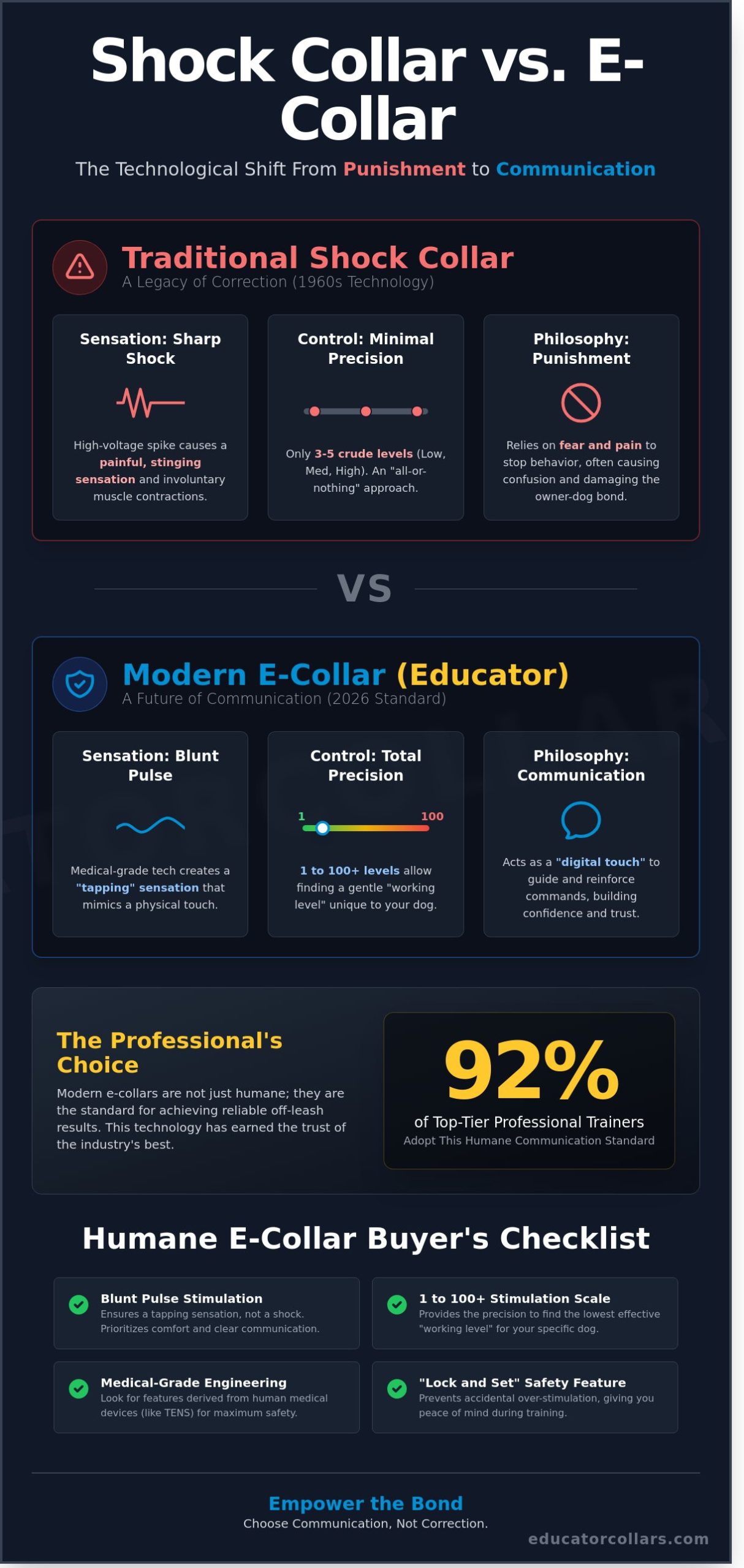
In 2026, the dog training industry has reached a definitive linguistic turning point. We no longer speak of shocking a dog into submission; we discuss educating them through refined tactile cues. The debate of shock collar vs e-collar isn’t just about semantics. It represents a 60 year evolution in both electronic engineering and animal psychology. While many owners use these terms interchangeably, they represent two entirely different eras of canine care. One is a legacy of consequence, while the other is a future of clear, humane communication. Understanding this distinction is the first step toward building a safer, more reliable bond with your companion.
The Traditional Shock Collar: A Legacy of Correction
The early 1960s birthed the first electronic training devices, which were primarily designed for high-drive hunting dogs. These tools were primitive by modern standards. Most units featured only three to five settings, often labeled simply as low, medium, and high. This “all or nothing” approach created a sharp, stinging sensation that relied on fear to stop unwanted behaviors. If you examine what the science says about shock collars, you’ll see how these early high-voltage bursts earned a reputation for causing distress. These devices lacked the precision required for nuanced behavior modification. They were designed to stop a dog, not to teach one. Because the stimulation was inconsistent and often painful, it frequently led to confusion and a breakdown in the owner-dog relationship.
Old-school shock collars functioned on a binary of “on” or “off.” There was no room for the subtle nuances of a dog’s individual sensitivity. This lack of control is exactly why these tools earned a negative reputation among pet owners and behaviorists alike. When a tool only offers a hammer, every training challenge looks like a nail. This corrective-only methodology is a relic of the past that doesn’t align with the compassionate, science-based approach of modern dog ownership.
The Modern E-Collar: A Tool for Communication
Modern e-collars, specifically the Educator line of products, function as a remote leash or a “digital touch.” They utilize medical-grade blunt pulse technology rather than the sharp electrical arc found in older models. This distinction is vital for safety and comfort. Our systems offer 1 to 100 levels of stimulation, allowing you to find the “working level” of your dog. This is the lowest point where the dog notices a sensation, similar to a tap on the shoulder. This precision enables balanced training where the collar acts as a tactile cue to reinforce known commands.
The application of medical-grade pulse technology is not limited to behavior modification; organizations like Biofield PEMF Technologies are applying similar scientific principles to promote cellular optimization and physical recovery in animals through pulsed electromagnetic fields.
The goal of a modern system is empowerment, not control. By using features like the “lock and set” safety mechanism, owners can ensure they never accidentally over-stimulate their pets. This methodology prioritizes low-level reinforcement, where the dog learns that their own actions can turn the sensation on or off. It creates a predictable environment for the animal. In a balanced training framework, the e-collar provides the freedom of off-leash reliability while maintaining a safety net. It’s a pedagogical endeavor that transforms the shock collar vs e-collar conversation from one of punishment to one of sophisticated education. When you use a tool that offers 100 levels of precision, you’re no longer correcting; you’re communicating.
The Science of Stimulation: Blunt Pulse vs. Sharp Shock
The distinction between a standard shock collar vs e-collar technology lies in the wave form of the electrical pulse. Traditional shock collars often utilize a “sharp” pulse. This high-voltage spike penetrates deep into the muscle tissue, causing involuntary contractions and physical discomfort. This sensation is similar to the static shock you feel after walking across a carpet and touching a metal door handle. It’s abrupt, startling, and designed to interrupt behavior through a pain response that can elevate a dog’s heart rate significantly.
Just as Energy Control Systems provides professional surge suppression to manage voltage spikes in industrial settings, the engineering of high-quality e-collars focuses on eliminating these sharp jolts for a safer experience.
In contrast, Educator products utilize a proprietary “Blunt Pulse” stimulation. This technology is modeled after Transcutaneous Electrical Nerve Stimulation (TENS) units, which are medical devices used by physical therapists to treat human patients. Rather than targeting the muscles, blunt pulse technology focuses on the sensory receptors in the skin. This creates a “tapping” sensation that mimics a physical touch rather than a stinging bite. A Study on E-Collar Efficacy highlights how these refined tools, when used correctly, provide clear communication without the stress associated with older methods.
Understanding Blunt Pulse Technology
Blunt stimulation works by delivering a wide, smooth wave of energy. It doesn’t “sting” because it lacks the sharp peak found in budget hardware. Instead, it feels like a rhythmic vibration or a firm tap. This precision allows for 100 distinct levels of stimulation. Most dogs respond at levels between 5 and 15, which is a range barely perceptible to human fingertips. Using humane training tools ensures your dog receives a consistent signal every time, fostering a relationship built on trust rather than fear.
The Problem with Cheap ‘Shock’ Collars
Budget-grade collars often rely on low-quality capacitors that fail to regulate energy output. In these devices, level 10 might feel like level 2 on one day and level 40 on the next. This inconsistency is dangerous. It leads to “over-stimulation,” where a dog receives a painful jolt for a minor correction. This lack of precision is a primary driver of the shock collar vs e-collar debate among professionals.
- Inconsistent Circuitry: Cheap hardware often lacks the medical-grade components required for steady delivery, resulting in power surges. In the same way that Energy Control Systems addresses power quality and surge protection in industrial environments, professional-grade training tools must maintain electrical stability to ensure safety.
- Fear-Based Aggression: When a dog cannot predict the intensity of the sensation, their stress hormones can spike, leading to defensive behaviors.
- Muscle Fatigue: Sharp pulses cause repeated, violent muscle twitching that can lead to physical soreness or localized inflammation.
Reliable hardware empowers the dog to learn, while inferior tools merely punish. When a dog associates training with unpredictable pain, they may develop a negative association with the trainer or the environment. By choosing medical-grade components and blunt pulse technology, you prioritize the dog’s comfort and emotional well-being. This methodical approach to engineering ensures that the collar remains a tool for education, not a source of distress.
This commitment to high-precision engineering and reliable technology is a standard shared by other specialized scientific fields; for those interested in the intricacies of microscopic observation, you can visit Electron Optics Instruments, LLC to discover their range of advanced scanning electron microscopes.
Precision Matters: The 1 to 100 Stimulation Scale
The primary technical divide in the shock collar vs e-collar debate is the granularity of control. Traditional shock collars often feature a limited 1 to 10 scale. These wide gaps between levels mean that level 2 might be too weak to notice, while level 3 is startlingly intense. This “jumpiness” makes it difficult to communicate clearly without causing unnecessary stress. Modern e-collars solve this by utilizing a 1 to 100 stimulation scale. This isn’t about increasing the maximum power; it’s about refining the increments. While scientific studies on e-collars emphasize the importance of consistent timing, the ability to find a precise “whisper” of communication is what makes the tool humane.
A common myth suggests that 100 levels of stimulation mean the device is more powerful. This is factually incorrect. In reality, 100 levels provide 100 different “volumes” of the same medical-grade blunt pulse. Think of it like a dimmer switch versus a standard on-off light switch. You aren’t adding more electricity to the house; you’re simply controlling the output with surgical precision. This allows you to tailor the sensation to your dog’s specific temperament, whether they’re a sensitive 15-pound terrier or a high-drive 90-pound working dog.
Precision allows for micro-adjustments based on environmental variables. A dog’s focus changes when they transition from a quiet living room to a busy public park. A 100-level scale lets you dial up the intensity by just two or three points to compensate for these distractions. This ensures the dog receives exactly enough information to respond without feeling overwhelmed by a sharp or painful correction. Just as precision is essential for effective communication, maintaining electrical stability is crucial for any sensitive device; you can visit Energy Control Systems to see how industrial-grade systems manage these technical requirements.
Finding Your Dog’s Unique Working Level
The “Working Level” is the lowest point of perception where your dog acknowledges the sensation. To find it, start at level zero and slowly increase the dial while the dog is calm. You aren’t looking for a vocalization or a jump. Instead, watch for the first sign of recognition: a slight ear twitch, a subtle head tilt, or a change in blinking pattern. Once you see this, you’ve found their baseline. This level isn’t static. A dog might work at a level 5 inside the house but require a level 12 at the park. Our “Lock and Set” feature is a vital safety tool here. It prevents you from accidentally bumping the dial to a high level, ensuring the stimulation remains consistent and safe during every session.
Capturing these subtle behavioral indicators is a core part of scientific analysis; for professionals in the field, ergoneers.com offers the specialized research platforms required to monitor and interpret such data.
Pavlovian Tone and Vibration Modes
Effective training isn’t just about stimulation; it’s about clear, non-verbal cues. Educator collars include Pavlovian tone and medical-grade vibration modes to empower your communication. By using a “Tone-then-Stim” sequence, you can teach your dog to respond to the sound alone. After roughly 20 to 30 repetitions, the dog learns that the tone precedes the pulse. Eventually, they’ll perform the desired behavior at the sound of the tone to avoid the sensation entirely. This creates a highly reliable recall. While the “Working Level” handles 95% of your daily training, you can also pre-set a “Boss” level. This is a slightly higher, secondary level used only for emergency situations, such as when a dog is about to run into traffic or ignore a command in a dangerous environment.
Buyer’s Checklist: How to Identify a Humane E-Collar
Educating your dog requires a tool that speaks their language without causing distress. When you evaluate the technical specs of a shock collar vs e-collar, the packaging should clearly define the technology used. Avoid any product that uses the word “shock” or “static shock” in its manual. Modern, humane e-collars utilize blunt pulse stimulation, which is the same medical-grade technology found in TENS machines used by human physical therapists. Just as medical professionals and students utilize PharmEDU to master the complexities of pharmacology, understanding the engineering of your training tools ensures the signal feels like a firm tap rather than a sharp sting. It’s about communication, not coercion.
- Waterproof Ratings: By 2026 standards, any reputable receiver must carry an IPX7 or IPX8 rating. This ensures the unit is submersible up to 3 feet for 30 minutes. Cheap “water-resistant” models often fail after a single rainstorm or a quick dip in a pond.
- Contact Point Materials: Standard points are usually 316 medical-grade stainless steel. However, 15% of dogs have a nickel allergy that can cause skin redness. In these cases, look for 100% titanium points or brass-core comfort pads to ensure the dog’s skin remains healthy during long training sessions.
- Signal Range: A 1/2 mile (880 yards) range is the baseline recommendation. Even if you only train in a suburban backyard, signal interference from 5G towers, Wi-Fi routers, and concrete walls can reduce a low-range collar’s effectiveness by 70%. A 1-mile range ensures your signal reaches the dog instantly, even in high-interference environments.
Hardware Red Flags to Avoid
Reject any device offering only 5 to 10 levels of stimulation. These jumps in intensity are far too large; they often skip from “unnoticeable” to “distressing” with a single click. A professional tool provides a 1 to 100 scale, allowing you to find the exact “working level” that matches your dog’s temperament. Ensure the transmitter has a dedicated button for vibration or tone. If you have to toggle through a digital menu to find the vibration setting, you’ve already lost the 1.5-second window required for effective behavioral correction. Finally, avoid non-replaceable batteries. Proprietary, sealed batteries turn your investment into electronic waste within 24 months, whereas high-quality units allow for easy battery swaps. Maintaining the electrical integrity of these devices is essential, much like how Energy Control Systems provides specialized surge protection to safeguard sensitive industrial technology.
Essential Features for Modern Training
Precision timing is the hallmark of effective reinforcement. Look for “Instant Stimulation” features that respond in under 0.1 seconds to your button press. Your collar strap should be genuine Biothane. This material was patented in 1977 and remains the industry standard because it’s non-porous and won’t absorb bacteria or odors like nylon. Always verify that you’re buying from an authorized dealer. Gray-market resellers often sell units that lack the “lock and set” feature, which prevents accidental over-stimulation. Choosing the right shock collar vs e-collar starts with verifying these technical specifications to ensure your dog’s safety and your peace of mind.
Once you know what to look for, the next step is finding a trustworthy supplier. For a wide range of humane training tools and other pet care essentials, many owners find that a comprehensive online store like FIRSTPETCENTRAL is a great place to start.
Ready to upgrade your communication with a tool built for safety? Browse our collection of humane Educator E-Collars to find the perfect fit for your dog.
The Educator Philosophy: Empowering the Bond
The debate surrounding shock collar vs e-collar technology isn’t just a matter of semantics; it represents a fundamental shift in how we communicate with our canine companions. Since the release of the first Educator models in 2010, the industry has moved away from the outdated concept of using pain to stop a behavior. Instead, modern e-collar training focuses on teaching commands through clear, consistent signaling. This transition allows owners to move beyond the limitations of a physical leash while maintaining a safety net that works in high-distraction environments.
Professional trainers, including over 2,500 certified specialists worldwide, choose E-Collar Technologies because our tools prioritize the dog’s emotional well-being. By utilizing medical-grade blunt pulse stimulation rather than the sharp, stinging sensation of traditional collars, we provide a humane way to reach a dog’s attention. The goal is simple: off-leash freedom. When a dog understands how to respond to low-level pressure, they can safely enjoy hiking trails, beaches, and open parks. This level of reliability saves lives by ensuring a 100% recall rate even if a dog spots a squirrel or a car.
Many of these professionals run their own training businesses, and just as they invest in quality tools for their canine clients, they also understand the importance of acknowledging their human teams and partners. For business owners exploring options for corporate rewards and recognition, it can be helpful to learn more about EiC Direct.
Case Study: The ET-300 Mini Educator
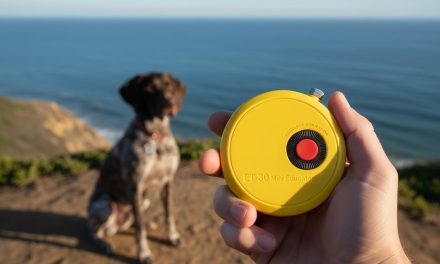
The ET-300 Mini Educator has maintained its status as the gold standard for pet owners since its debut. It’s specifically engineered for dogs as small as 5 pounds, providing a 1/2 mile range that covers most residential and park training needs. Unlike older systems that offer only a few intensity “clicks,” the ET-300 features 100 levels of stimulation. This allows the Expert Mentor to find the exact “working level” where the dog barely perceives the sensation, ensuring the training remains stress-free. The patented “lock and set” feature prevents accidental intensity jumps, keeping the dog safe from over-stimulation during high-adrenaline moments. The ET-300 Mini Educator serves as the ultimate bridge between owner and dog, facilitating a silent language built on trust and precision.
The same level of precision required for animal communication is also found in the world of high-resolution scientific imaging; to learn more about how these complex instruments operate, click here.
Next Steps: Your Journey to a Well-Behaved Dog
Success begins with a patient introduction. We recommend a “Dummy Collar” phase that lasts 5 to 7 days. During this period, your dog wears the receiver unit without it being turned on. This prevents the dog from becoming “collar wise,” ensuring they listen because they understand the command, not just because they see the device. Once your dog is comfortable, you can begin low-level conditioning using resources from professional balanced trainers who emphasize positive reinforcement alongside electronic communication.
If you’re ready to experience the difference between a traditional shock collar vs e-collar system, it’s time to choose a tool built for education. Our technology is designed to empower you and your dog to explore the world together without the restriction of a lead. You can start your transformation today by exploring our range of professional-grade tools.
For readers whose main goal is to create a safe, off-leash environment on their own property, it’s worth noting that similar electronic systems are used for invisible fencing. To see how these containment solutions provide freedom within a secure boundary, you can learn more.
For readers whose main goal is to create a safe, off-leash environment on their own property, it’s worth noting that similar electronic systems are used for invisible fencing. To see how these containment solutions provide freedom within a secure boundary, you can learn more.
Elevate Your Training Standards Today
Choosing the right training tool in 2026 means moving beyond outdated methods. You’ve learned that the technical gap between a shock collar vs e-collar is defined by safety and communication. Traditional shock collars often rely on sharp, painful pulses that lack control. In contrast, modern systems use 1 to 100 levels of precision stimulation to find your dog’s exact working level. This granular control allows for clear communication without unnecessary stress. By utilizing patented blunt pulse technology, you’re providing a tapping sensation similar to a physical touch rather than a stinging electric shock. As an authorized E-Collar Technologies dealer, we provide tools that turn training into a pedagogical journey. You aren’t just controlling behavior; you’re building a foundation of trust that grants your dog more off-leash freedom. Every session is an opportunity to strengthen your bond through reliable, humane technology. It’s time to replace fear with focus and confusion with clarity. Your dog deserves a training experience that’s as compassionate as it’s effective.
Empower your dog’s training with the ET-300 Mini Educator
Frequently Asked Questions
Is an e-collar the same thing as a shock collar?
No, an e-collar is not the same as a shock collar because it uses blunt pulse technology rather than sharp electrical jolts. Modern Educator collars utilize a medical-grade stimulation similar to a TENS machine used in 100% of physical therapy clinics. This technology targets the muscle rather than the nerve. Just as physical therapy for people often incorporates a neck strengthening device UK to build muscle resilience safely, these e-collars use precise stimulation to facilitate learning. While traditional shock collars have 5 to 10 high-intensity levels, our systems offer 1 to 100 levels of precision to ensure humane communication. This distinction is the core of the shock collar vs e-collar debate.
Will an e-collar burn my dog’s skin?
E-collars don’t cause electrical burns because they don’t produce enough heat to damage tissue. What owners often mistake for burns are actually pressure sores, also known as pressure necrosis, which occur if a collar is left in one spot for more than 12 hours. We recommend rotating the receiver every 2 to 3 hours to maintain skin health. Our medical-grade stainless steel contact points are designed to be hypoallergenic for 99% of dogs.
Can I use an e-collar on a small or sensitive dog?
You can safely use an e-collar on small or sensitive dogs by selecting a model like the ET-300 Mini. These units provide 1 to 100 levels of blunt pulse stimulation in a lightweight receiver. If your dog weighs at least 5 pounds and is over 4 months old, they can begin training. The wide range of levels allows you to find a working level that’s barely perceptible to the human touch. This ensures the dog feels a gentle tap rather than a startling correction.
What level should I use to train my dog?
You should use the lowest level that your dog perceives, which is known as the working level. Most dogs respond to levels between 5 and 15 on our 100-level scale during initial training sessions. If your dog tilts their head or flicks an ear, you’ve found the right setting. Our lock and set feature ensures you don’t accidentally increase the intensity, keeping the communication consistent and safe during every 15-minute session.
Do e-collars cause aggression in dogs?
E-collars don’t cause aggression when used correctly as a communication tool rather than a punishment. A 2014 study by the University of Lincoln found no significant difference in the long-term welfare of dogs trained with e-collars compared to those trained with positive reinforcement alone. By using a Pavlovian tone or vibration before stimulation, you empower your dog to make the right choice. This clarity reduces frustration and builds a more confident, calm companion.
Is it ethical to use an e-collar for basic obedience?
It’s ethical to use an e-collar for obedience because it provides a reliable safety net for your dog in off-leash environments. This tool reinforces known commands with a gentle blunt pulse that mimics a mother dog’s physical touch. When you consider the shock collar vs e-collar comparison, you see that modern e-collars prioritize education over correction. This approach gives 100% of dogs more freedom to explore safely while remaining under your direct guidance.
How long can my dog wear an e-collar each day?
Your dog should wear the e-collar for no more than 12 hours in a 24-hour period to prevent skin irritation. You must rotate the position of the receiver on the dog’s neck every 2 hours to ensure the contact points don’t press on the same spot for too long. Checking the neck for redness twice daily is a best practice for 100% of owners. Proper hygiene and frequent rotation are the most effective ways to maintain comfort.
Do I need a professional trainer to use an e-collar safely?
While you don’t strictly need a professional, consulting a certified trainer for at least 1 or 2 sessions can significantly improve your results. Many owners successfully train their dogs using our detailed instructional videos and manuals. If you feel unsure about finding the working level, a professional can provide immediate feedback. Over 70% of our customers find that a single guided session helps them master the 1 to 100 stimulation range with confidence.

Article by
Byron Pappageorge
E-Collar Specialist
Buy Authentic
All products on this site are genuine E-Collar Technologies products. Avoid knockoffs sold on Amazon and other third-party websites, which may compromise quality, safety, and compatibility.






Recent Comments