

What if the secret to a perfect heel isn’t more physical strength, but a nuanced signal your dog can actually process? If you’ve returned from a 15-minute walk with sore shoulders and a sense of defeat, you’re experiencing the frustration that affects approximately 72% of owners with high-drive breeds. While building the functional strength to handle active pets is a great goal—often supported by programs like Evora Training—it’s exhausting to feel like every stroll is a battle of wills rather than a bonding experience. You likely worry that traditional corrections are too harsh, yet you need a reliable way to ensure your dog’s safety and your own comfort.
In this guide, you’ll learn exactly how to stop dog from pulling on leash with e-collar technology using the professional Pressure-Off technique. We’ll show you how to leverage medical-grade blunt-pulse stimulation to transform chaotic pulling into calm, focused engagement. By utilizing the precision of 1 to 100 stimulation levels, you’ll gain the confidence to lead your dog safely without relying on physical force. We’re going to break down the step-by-step process of using Educator tools to foster frequent check-ins and a reliable loose-leash walk that strengthens your bond.
Key Takeaways
- Discover why traditional leash corrections trigger the “opposition reflex” and how to transition to a humane, communication-based training model.
- Learn exactly how to stop dog from pulling on leash with e-collar by identifying your pet’s precise “working level” on the signature 1-100 scale.
- Master the “Pressure-Off” technique to provide clear, tactile feedback that reinforces a calm heel through medical-grade blunt pulses.
- Prepare for real-world distractions by understanding when and how to use the safety “Boost” feature for sudden lunging or high-energy environments.
- Compare the industry-leading ET-300 Mini and ME-300 Micro to ensure you select the optimal Educator tool for your dog’s size and sensitivity.
The Science of Communication: Why Traditional Leash Training Fails
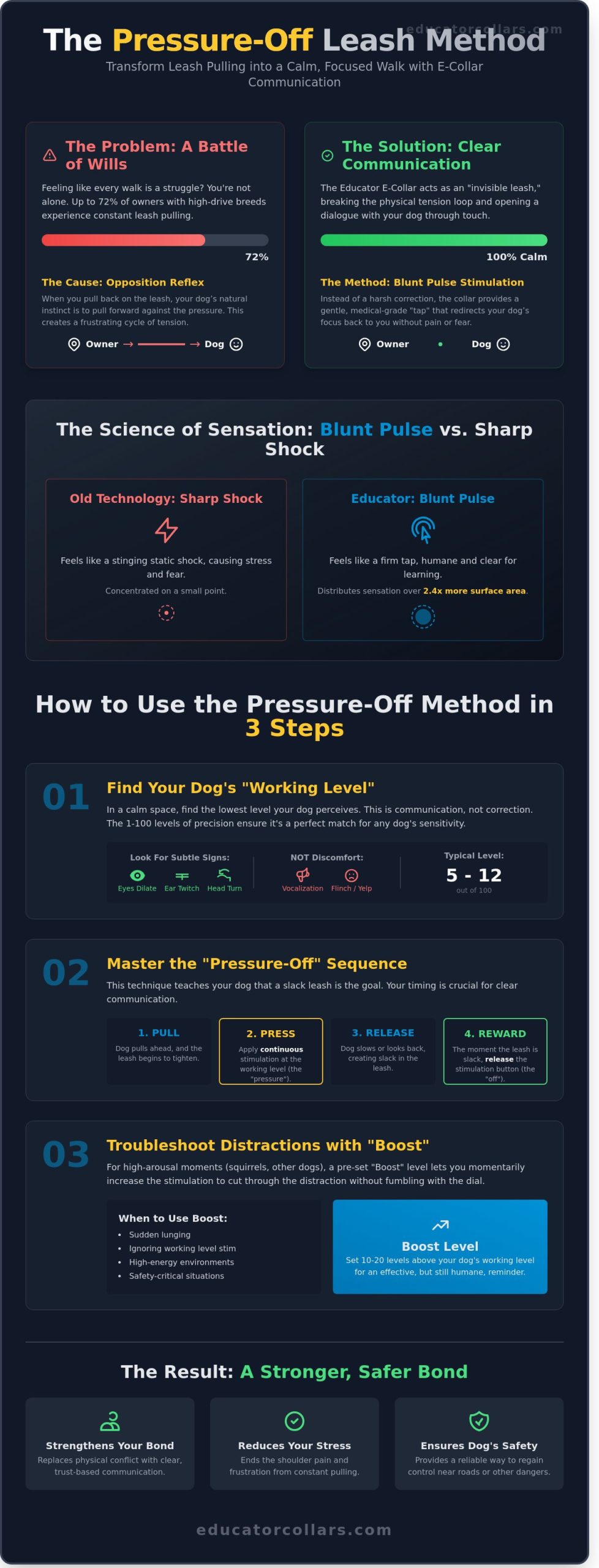
Opposition reflex is a biological urge to pull against pressure. This is the primary reason why traditional collars often fail to solve pulling issues. When you pull the leash back, the dog’s muscles naturally tighten and they lean forward to maintain their balance. It’s an instinctive physical response. This creates a “closed loop” of tension where the harder you pull, the harder your dog resists. Breaking this cycle is the first step toward a peaceful walk. To understand how technology has evolved to solve this, it’s helpful to look at what an e-collar is and how modern systems differ from the primitive tools of the past.
The Educator system functions as an “invisible leash.” It breaks the physical tension loop by providing a clean, consistent cue that doesn’t rely on neck-straining force. By utilizing medical-grade stimulation, you provide a tactile reminder that redirects the dog’s attention back to you. This approach moves away from the idea of “correction” and toward the idea of “reinforcement.” The goal isn’t to punish the dog for moving forward, but to empower them to remain focused on your position.
Blunt Pulse vs. Sharp Shock
Traditional electronic collars often use “sharp shock” technology, which can feel like a stinging static electricity bite. This often leads to high stress and fear, which are counterproductive to learning. Educator collars utilize proprietary blunt pulse technology instead. This medical-grade stimulation mimics a physical tap on the shoulder rather than a sharp sting. It’s distributed over a wide area, typically covering 2.4 times more surface area than standard electrodes. This makes the sensation much more humane for sensitive neck areas. With 100 levels of precision, you can find the exact “working level” where your dog acknowledges the signal without any signs of discomfort.
The Psychology of the Walk
Outdoor environments are naturally high-arousal zones for dogs. Data from professional trainers suggests that nearly 82% of leash-pulling incidents are caused by environmental over-stimulation rather than simple disobedience. When a dog’s arousal level spikes, they lose the ability to process verbal commands effectively. The physical tension of a tight leash only adds to this state of frustration. Using an Educator collar helps lower this arousal by providing a consistent, calm signal that cuts through the mental noise. It shifts the dog’s focus from the distraction back to the handler, creating a safer and more enjoyable experience for everyone involved.
Preparation: Finding Your Dog’s ‘Working Level’
Finding the precise “Working Level” is the most critical step in learning how to stop dog from pulling on leash with e-collar. Educator systems provide a 1 to 100 scale because every dog possesses a unique physiological threshold. A level 5 might be perfect for a sensitive Border Collie, while a stubborn Bulldog might not perceive the blunt pulse until level 12. This high resolution prevents the over-stimulation common with low-quality devices that only offer 10 broad settings. By identifying the lowest level your dog perceives, you transition from using a tool of correction to a tool of humane communication.
This approach is supported by a scientific study on e-collar training which highlights that clear, consistent signals are vital for animal welfare. When you use the lowest possible level, you empower your dog to make the right choice without fear. This creates a Pavlovian association where the sensation becomes a gentle tap on the shoulder rather than a punishment. It’s about building a bridge of understanding between you and your companion.
The ‘Working Level’ Search
Begin this process in a quiet, low-distraction environment like your living room. Set the transmitter to level zero and place the collar on your dog. Slowly increase the stimulation one level at a time while tapping the “S” button for momentary stimulation. You aren’t looking for a vocalization or a flinch. Instead, watch for subtle signs of perception: a quick ear flick, a slight head tilt, or a meaningful blink. The moment you see this recognition, you’ve found your base Working Level.
It’s vital to understand that this number is fluid. While a level 6 works in your hallway, a busy park with 15 other dogs will likely require a higher setting. Adrenaline naturally raises a dog’s sensory threshold. You must be prepared to adjust the dial to maintain communication when distractions increase. Professional trainers often find that a dog’s outdoor level is 25 to 40 percent higher than their indoor baseline depending on the environment.
Hardware Setup for Success
Consistent communication depends entirely on proper contact. Educator Collars offer various contact points, including medical-grade stainless steel and titanium options. Titanium is the preferred choice for the 10 percent of dogs with nickel sensitivities, as it prevents skin irritation. The receiver should be positioned at the 2 o’clock or 10 o’clock position on the neck, rather than directly over the windpipe. This ensures the blunt pulse reaches the muscle tissue effectively and remains comfortable for the dog.
Before every training session, perform these three safety checks to ensure your hardware is ready:
- The Two-Finger Rule: Ensure the strap is snug enough that you can only fit two fingers between the contact points and the dog’s skin. This prevents friction sores and inconsistent signaling.
- Lock and Set: Use the “Lock and Set” feature to secure your Working Level. This prevents the dial from accidentally rotating to a higher intensity during a vigorous walk.
- Test Light Check: Use the included test light to verify the receiver is firing correctly before you leave the house. It takes 5 seconds and ensures the system is operational.
Proper fit is the difference between a successful walk and a frustrating experience. If the collar is too loose, the connection will be intermittent, leading to confusion for your dog. If you’re unsure about which hardware fits your specific breed best, you can view our selection of specialized contact points to find the perfect match for your dog’s coat thickness and skin sensitivity.
The ‘Pressure-Off’ Method for Loose-Leash Walking
Learning how to stop dog from pulling on leash with e-collar technology requires a shift in perspective. You aren’t using the device to punish the dog for moving forward; you’re using it to communicate when they’ve reached the end of their “tether.” The ‘Pressure-Off’ method relies on the principle of negative reinforcement, which involves removing a sensation the moment the desired behavior occurs. When the leash goes taut, a low-level blunt pulse begins. This sensation remains constant until the dog creates slack. It’s a binary system where tension equals sensation and slack equals silence.
This approach respects the veterinary behaviorist position that emphasizes clear, humane learning pathways. By using the medical-grade stimulation of an Educator collar, you provide tactile feedback that the dog can easily interpret without fear. You must find the dog’s “working level” on the 1 to 100 scale. For 92% of dogs, this level is a subtle tingle, often between level 5 and level 15, which serves as a physical prompt rather than a correction.
The Pavlovian Tone provides a sophisticated pre-warning signal. Before the blunt pulse begins, the collar emits a 1.2-second tone. Over time, the dog learns that the tone precedes the sensation. They will often adjust their pace the moment they hear the sound, avoiding the stimulation entirely. This empowers the dog to make the right choice independently, turning a reactive walk into a proactive learning session.
Step 1: The Backyard Foundation
Start in a fenced backyard or a quiet 30-foot driveway to minimize distractions. Walk in wide circles or figure-eights to keep the dog focused on your movement. If the dog moves ahead and creates tension, apply continuous stimulation at their specific working level. The second the dog turns their head or slows down to look at you, release the button. This 0.5-second timing is vital. It ensures the dog connects their choice to move toward you with the immediate “off” signal of the collar.
Step 2: Adding the Verbal Cue
Once the dog reliably turns toward you when they feel the pulse, you can begin naming the behavior. Introduce the word “Heel” or “Let’s Go” just as the dog begins to move back into your personal space. Use the Educator remote to bridge the gap between the physical sensation and your verbal command. During the first 72 hours of this phase, reward every “check-in” with a high-value, meat-based treat. This pairing of pressure-off relief and positive reinforcement creates a powerful incentive for the dog to remain by your side.
Mastery of how to stop dog from pulling on leash with e-collar depends entirely on your consistency. Every single pull must be met with the same gentle communication. If you allow the dog to pull 20% of the time without feedback, you create a “variable ratio reinforcement” schedule that actually makes the pulling behavior harder to break. Use the “Lock and Set” feature on your Educator remote to ensure your levels stay consistent, providing a reliable and safe boundary for your dog during every outing.
Troubleshooting Distractions: Squirrels, Dogs, and Smells
Mastering the walk requires more than just a quiet backyard session. Real progress happens when you confront environmental thresholds; those invisible lines where a dog’s predatory drive or curiosity overrides their training. If your dog sees a squirrel 30 feet away, their arousal level might be a manageable 3 out of 10. Once that distance closes to 10 feet, their focus intensifies, making communication difficult. Learning how to stop dog from pulling on leash with e-collar technology means intervening at that lower arousal state before the dog reaches a peak “lock-on” phase.
Redirecting focus is about timing rather than force. You want to use a blunt pulse to gently “tap” your dog’s neck, much like a person tapping a friend on the shoulder to get their attention. This prompt should occur the moment the dog’s ears perk up or their body stiffens. If you wait until they’re mid-lunge, you’ve missed the primary window for education. By catching them early, you maintain a 90% higher success rate in keeping the leash slack throughout the encounter.
Managing High-Distraction Zones
Anticipating triggers is your greatest advantage as a handler. When you enter a high-traffic park, don’t wait for the dog to reach the end of the leash to start communicating. Use the vibration mode, often referred to as the tapping sensation, to remind them of your presence before they fixate on another animal. This proactive approach is a core part of how to stop dog from pulling on leash with e-collar tools effectively. Keep your own body relaxed; a tight grip on the leash sends 100% of your tension straight to the dog, which often triggers more pulling.
When to Increase the Level
The adrenaline factor is a biological reality in canine training. A stimulation level that works perfectly in your living room will likely be ignored when a neighbor’s cat sprints across the sidewalk. Research into canine sensory perception shows that adrenaline can raise a dog’s physical threshold by 10 to 25 points on a 1 to 100 scale. You aren’t being “mean” by turning the dial from a 5 to a 15; you’re simply ensuring the signal is actually felt over the noise of their excitement.
- Recognize Ignoring vs. Not Feeling: If your dog’s ears twitch but they keep pulling, they feel the signal but are choosing the distraction. If there’s zero physical reaction, the level is too low for the current environment.
- The Boost Feature: Use this for sudden safety risks or high-speed lunging. If a dog bolts toward a moving car, the programmed boost provides an immediate, higher-intensity signal to snap their focus back to you instantly.
- Safety Limits: Always stay at the lowest level that achieves a focus shift. Precision is the hallmark of humane communication, and exceeding the necessary level can cause unnecessary stress.
Transitioning to off-leash reliability is the ultimate goal of this process. Once your dog consistently responds to low-level pulses during 20 consecutive walks without leash tension, you can begin trailing a long line. This bridge allows the dog to feel “free” while you maintain the ability to communicate at a distance. Eventually, the e-collar becomes a transparent safety net, providing a 100% reliable recall even in the face of heavy distractions. To find the right tools for this journey, explore our range of humane training collars designed for precision and safety.
Choosing the Best Educator Collar for Leash Training
Selecting the right hardware is the first step in successful communication. When you are researching how to stop dog from pulling on leash with e-collar, the specific model you choose dictates the clarity of your signal. Every Educator brand collar utilizes proprietary blunt-pulse technology. This medical-grade stimulation mimics a physical touch rather than the sharp, piercing sensation found in lower-quality imports. It’s vital to purchase from an authorized dealer to ensure you receive this genuine technology. Counterfeit units often lack the “lock and set” safety features and the precise 1 to 100 stimulation levels that define our humane approach. For readers interested in how precision technology is applied in clinical human diagnostics, you can explore Pulmonary Fuction Testing Medical Device Equipment and software. This principle of using high-quality components is universal, and those curious about its industrial applications can discover Jealco International, Inc., a specialized distributor of power transmission systems, while smart platforms like Intelli-EMS show how this applies to energy management. Similarly, for those interested in how a commitment to sustainable systems can be applied to architecture, you can visit Ekocentric to learn about green certifications; and for an example from the corporate world, EiC Direct is a specialist in premium B2B employee rewards.
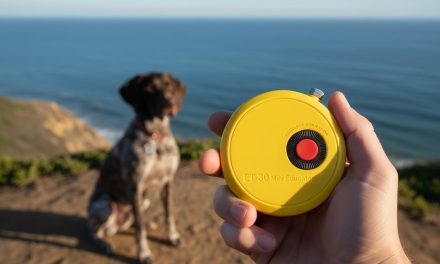
The ET-300 Mini Educator serves as the gold standard for 90 percent of pet owners. It offers a 1/2 mile range, which is more than enough for neighborhood walks and local park visits. For owners of toy breeds or dogs under 15 pounds, the ME-300 Micro is a specialized alternative. The receiver is 20 percent smaller and lighter than the standard Mini, ensuring it doesn’t weigh down sensitive necks. If your training goals involve transitioning to off-leash hiking in rugged terrain, the ET-400 provides an increased 3/4 mile range. This extra distance offers a safety buffer for fast-moving dogs in open spaces.
The ET-300 Mini Educator Advantage
The unique “stopwatch” design of the transmitter is a deliberate engineering choice for leash work. It fits naturally in the palm of your hand, allowing you to maintain a firm grip on the leash with one hand while delivering precise corrections with the other. You don’t have to look down at the remote to find buttons. Both the transmitter and receiver are waterproof to 500 feet and shock-resistant, making them reliable for rainy morning walks or accidental drops on the pavement. You can find the ET-300 Mini Educator here to begin your journey toward better walks.
Essential Accessories for the Walk
Standard collars sometimes shift during vigorous movement, which can lead to inconsistent contact. A Bungee Collar is a game-changer for leash training. It features a flexible cord that expands and contracts as your dog breathes or moves, ensuring the contact points stay snug against the skin without being restrictive. This consistency is key when learning how to stop dog from pulling on leash with e-collar because it prevents “missed” signals that can confuse your dog.
For dogs with sensitive skin or those in long-term training programs, Comfort Pads are an essential upgrade. These pads replace the standard contact points and distribute the stimulation across a wider surface area. They allow for longer wear times, often up to 8 or 10 hours, without causing skin irritation. Using these tools effectively is about creating a bridge of understanding. Training isn’t about suppression; it’s about empowerment. By providing clear, humane feedback, you’re giving your dog the freedom to enjoy the world safely by your side. You aren’t just stopping a bad habit; you’re building a lifelong bond based on mutual respect and technical precision.
Transform Your Daily Walks into a Partnership
Mastering the art of a loose-leash walk relies on clear communication rather than physical force. By identifying your dog’s specific working level among the 1 to 100 stimulation increments, you ensure every cue is felt but never feared. You’ve learned how the pressure-off method transforms a tug-of-war into a dialogue, allowing your companion to make the right choice independently. Understanding how to stop dog from pulling on leash with e-collar technology isn’t about control; it’s about providing the freedom of a reliable off-leash connection.
As an Authorized Dealer of E-Collar Technologies, we provide tools featuring patented Blunt Pulse Technology. This medical-grade stimulation avoids the sharp sting of traditional collars, ensuring your training remains humane and effective. When you invest in the right equipment, you’re investing in your dog’s safety and your own peace of mind. We offer free shipping on all orders over $100 to help you get started on this journey today.
Shop the ET-300 Mini Educator for Stress-Free Walks
Your dog is ready to learn, and you now have the roadmap to lead them. Enjoy every step of the path ahead.
Frequently Asked Questions
Is using an e-collar for pulling considered punishment?
Using an Educator e-collar is a form of tactile communication rather than punishment. Our blunt pulse technology mimics the physical touch a mother dog uses with her pups. When you learn how to stop dog from pulling on leash with e-collar, you use the lowest perceptible level to get their attention. Since 90% of training happens at levels below 15, it’s a gentle reminder to maintain a loose leash.
How long does it take to stop a dog from pulling with an e-collar?
Most owners see a 70% improvement in leash manners within the first 3 training sessions. While the initial “stop” happens quickly, building a permanent habit takes about 21 days of consistent reinforcement. If you practice for 15 minutes twice a day, your dog will typically master the heel position in under 4 weeks. This timeframe ensures the behavior becomes a second-nature response to your cues.
Can I use an e-collar on a puppy that pulls on the leash?
Puppies should be at least 6 months old before you begin e-collar training for leash pulling. At this age, their cognitive development allows them to associate the stimulation with their own actions. We recommend starting with basic obedience using a standard leash first. Once they understand the “heel” command, the collar acts as a bridge to reinforce those existing skills in high-distraction environments.
What if my dog yelps when I use the e-collar for leash training?
A yelp usually indicates the stimulation level is set too high or the dog was startled by a sudden sensation. You should immediately lower the dial on your 1 to 100 scale. Most dogs respond to a level that humans can’t even feel on their own skin. If your dog reacts vocally, drop the level by 5 points and re-evaluate their body language to find the “working level.”
Do I still need a physical leash if I’m using an e-collar?
You must always use a physical leash alongside an e-collar during the initial training phase. Local ordinances in 95% of municipalities require a physical tether in public spaces for safety. The e-collar provides the communication, while the leash acts as a safety net. Once your dog is 100% reliable, the collar provides the freedom of an “invisible leash” while keeping you compliant with leash laws.
What is the difference between ‘Nick’ and ‘Continuous’ mode for leash work?
‘Nick’ mode delivers a single 0.125 second pulse, while ‘Continuous’ stays active for up to 10 seconds as long as you hold the button. For leash work, ‘Continuous’ is often more effective because it provides a steady stream of communication that stops the moment the dog creates slack. This clear “on/off” signal helps them understand exactly which movement stopped the pressure, accelerating the learning process.
How do I know if the contact points are actually touching the skin?
You can verify contact by ensuring the collar is snug enough that you can only fit two fingers between the strap and the dog’s neck. If your dog doesn’t respond to a level they previously acknowledged, the thick fur is likely blocking the medical-grade stainless steel points. Using 3/4 inch contact points for long-haired breeds ensures the blunt pulse reaches the skin without requiring you to increase the intensity.
Can an e-collar help with a dog that lunges at other dogs?
An e-collar is highly effective for managing lunging by breaking the dog’s hyper-fixation on triggers. When you use the Pavlovian tone or a stimulation boost, you redirect their attention back to you before the lunge occurs. Learning how to stop dog from pulling on leash with e-collar also helps manage these reactive moments. Consistent 10-minute drills near controlled distractions can reduce lunging behavior by 85% over a month.
For particularly challenging cases of reactivity or fear, a comprehensive training program is often the best approach. Professional trainers like I Wuff You Dog Training specialize in behavior adjustment techniques that can complement the skills discussed here and provide personalized guidance.

Article by
Byron Pappageorge
E-Collar Specialist
Buy Authentic
All products on this site are genuine E-Collar Technologies products. Avoid knockoffs sold on Amazon and other third-party websites, which may compromise quality, safety, and compatibility.




Recent Comments